
Zenji

Land of my ancestors

I suppose, finally content with the fertile hilly soils, they decided to settle here. Colonialism found them here and in 1921, when the walls were going up, they were to realise that they were no longer just Bakongwe, Ba Mwisa Murengye, they would be Bakiga, but above all there would be forever be known as Ugandans. And with their taabes, and their anklets, their beads and animal skins, their gods too small, their names too singular, half dressed for the modern world, they entered the new era. There would be no more wars with their neighbours for loot and for women. It was time for school, for work, for nationality.

They were known for their strength and their stout figure, hardly unsurprising for a body built to climb steep altitudes. They are disparaged for their dialect- haughtily laughed up for speaking so crudely. Any deviation from the figure which has been cookie cut out for them is seen as mishap- not known for their beauty, for their soft spoken-ness or for their measured slow steps. No, that was not what their society hailed, then, it prized the strong, those who could cultivate and have dominion over the land and even the food they ate, was meant to build a machine.

But there was and is beauty in the culture and in the people, and once the comparisons end, it always begins. Skin colours appear, mystically, to range from shades of bright yellow to a warm black. But the tooth gap is no longer exaggerated by picks. There are no more heavy metal anklets worn up to the knees- those are for loose women. And so, even though, what was prized then, is no longer what is prized now, it is good to remember that, even the pharaohs were once great.

For a people who were well known for battle and dominance, the strive to keep the blood pure did not become one of the core values. They were not full – not of themselves- they- picked and mixed intonations and dialects of a similar language, pouring into and taking part of various ethnicities. Finally, the belittling and the complexes of others surrounding them have seeped into the genetics of the remainders- others have renounced the name, renounced the language for fear of being derided. Sweeping things under the carpet, calling spades big spoons, hiding behind the bush- these are new age tactics. They must be learnt. Every thing that doesn’t grow, will soon die. I guess. That is what they say.

If a factory is torn down but the rationality that built it is left standing, then that rationality will simply produce another factory. If a revolution destroys a systematic government but the systematic patterns of thought that produced that government are left intact, then those patterns will repeat themselves.Robert M Pirsig

The time has come for a nation and faced with enemies other than ourselves, stronger, more powerful, quicker and futuristic, we as Ugandans and Africans should have made ourselves as one, but we crumbled at first exposure.

We have given all excuses as to why we have not redesigned the future we hope for, the word colonialist, a stale taste in the mouth. We gained the independence to destroy what was left. Every election season since I could vote, I have shuddered at the little things- the first to go would be the natural hair community vlogs- what, with refugee status- how can one afford to think about what curl pattern they have. I have not allowed myself to think about the other more serious things- only in my dreams do they confront me- blood. loss. ashes.

It’s the African curse. Once built, always crumbles. Stealing from the generation to come, stifling their own chance to survive, always to fill the black hole of greed, with the shortsightedness of a drunkard – drunk with power who would commit their own kind to years of damnation, generations whose conversations will not be, of vaccines, rockets and skyscrapers but civil war, poverty, genocide, strife and military coups. Cry the beloved country.
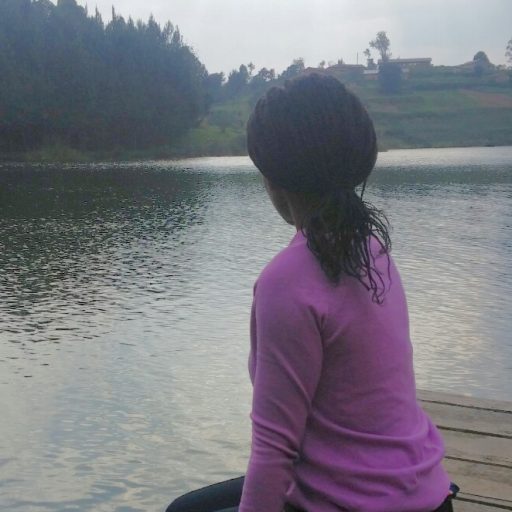
LIFE

Touching Ground

The first time we were on the lake, in its dark sky-blue expansiveness, we used a canoe. We floated on its roughly cut planks of wood finding a makeshift sitting place within its irregular inner structure. As we swooshed on into the water, it turned a dark green colour with strings of moss underneath. The canoe men who steered the boat, used cut outs of jerrycans to pour the water out of the boat when it sipped in. But even that did not scare me, the heart of a young girl would jump from a cliff into the vast deep if it was with the man she loves.

It was a four hour journey to the island and the lake was calm and joyful. The sun sparkled onto our faces and the silhouette of the islands faraway comforted us; but even when all we could see was lake all around us, I was certain that we would be safe. The water held us in its palm throughout and except for a sprinkling of water from the vibrating engine at the back of the boat, we were just two voices speaking in a bubble, in the backdrop of a 68,800 square metre water body.

The two lake-men had packed sachets of waragi for their journey but they agreed to resist them until we reached the shore. I had wondered out loud in disbelief as to why they had to dose themselves in alcohol and yet were relying on them to take us on a journey so far away. I had heard that the people of the lake were very superstitious, that they had seen things, that they made sacrifices to please the water. I scoffed at their naivety.

Seven years since we had been on that canoe, we came back to the lake, this time on a passenger speedboat; not just two people and two canoe men on a rough wood canoe with leaking holes and broken jerrycans. This boat had a powerful engine. It could accommodate up to 54 passengers, take us to our destination in one and a half hours, with a lavatory in the back, life jackets in the upper head shelves and an automatic inflatable raft at the top. The seats were covered in faux leather and there were windows; big enough for me to see the lake expand and contract, into a depth that only before seemed superficial; big enough for me to see a massive tide rush towards us, lift the boat atop it, push us off our linear path and drop us back into the deep.

The journey to the island had been lulling. I had slept through the last part of it and awakened to a uniform tall green forest curving against the soft dark blue. It was the start of the weekend that marked the end of a heavily loaded year as I climb out of my twenties.

On the day we left the island, unlike the day before, the clouds were grey and foreboding and it was drizzling. But we had been on the lake before, with no land in sight, on a smaller mode of transport, with two fishermen we had just met. BUT, water is deceptive. The drizzle that just barely kissed the surface of the water and the 54 passenger boat could both fit into the wide gaps that unexpectedly appeared in the water, swallowing it whole, leaving no footprint on it, as if we were never there.

As we settled into our seats, I pointed out how earlier in the morning, the water had been pulsing towards the shore and now it was rocking gently away in the opposite direction . As soon as we set off, a few happy travelers, some of whom we had made friends with over the weekend, requested to stand on the deck. With their party music on blast, we heard them shout, “One last round for the road!”

Not more than ten minutes later, one by one, they came back to their seats. The wind was unrelenting and the water it stirred up had left them drenched. The once soothing waves had become so high and violent and the farther we went, the more turbulent they became. Soon the waves came rushing towards us, pushing us away from our linear navigation, tossing us high upon its waves and letting us drop into its depressions. As we tumbled on, on our trek onto the mainland, unable to go backwards and unwise to stay still, I started to realise that even if we managed to float, the rushing large volume of water would first push us under long enough for us to swallow half our body weight in water.

I had underestimated it. Nalubaale. We were just a paper boat in the middle of an ocean and we had overestimated our power. As the lake expanded and its waves threatened to blanket the boat, I thought of the landscape underneath. Mountains? Vast stretches of sand that had covered those it had claimed before us? The people who had lived here centuries before, had personified the lake and as our powerful engine boat fought for balance I could see why the Nalubaale had taken up the natural characteristics of a human being. The lake could get happy or sad. The lake could get hungry or it could be asleep. In that moment, I could sense its fury.

As we continued to swing and fall, the music had stopped, and those still talking, were either praying, gasping or asking questions. You can tell how turbulent it is when you begin to ponder on the captain’s credentials. Your mind rummages within its contents and brings up thoughts of MV TEMPLAR and the last calls to ‘balance the boat’. And you look ahead saying, God, if I touch the ground again.

The family in front of us, a father, his veiled wife and five daughters, three of whom were also veiled sat un-moving. They did not hurdle together and if they prayed, they prayed in their hearts. There are some religions which fear hell more than they fear death. Even though I saw relief on the father’s face much later, I had not seen him as much as cast a glance towards even his wife.

The sound of the engine struggling to keep up was like complete nonsense in comparison to the heaving to the might of the water. Calm the sea. Calm the sea. Don’t you know that if you say to the storm… We held onto the jackets, knowing that that the bright orange covered foam and plastic life boat would no longer be enough to shield us from a lake that was eager to swallow everything that was moving a top it.

The feeling was familiar. It had hit me on the first flight I took after becoming a mother. Sitting next to the man I had leaned for years, the wheels of the metallic structure we had voluntarily boarded, started running against the tarmac and it attempted to lift itself and fly. It rose sharply to the sky, the sound of its old wings rattling against the wind, 243 people on board, two of whom had said quick goodbyes to their 8 month old baby (quick so as not to upset him), it fought against gravity and came out on top of the clouds. Somewhere in the white fluff, 10,000 metres above sea level, I realised that I had nothing else to hold me. I was only in the hands of the Spirit who made me, as I had always been. With no ground to hold me up, and, you know, the wind is not in the habit of catching people, there was nothing else to rely on but the Spirit who once moved upon the dark waters creating things. God, I don’t have the ground to hold me now. I have only You. But should my feet touch the ground again, I will be grateful.